

The demand for connected teaching and presentation systems is reshaping China’s professional audio-visual manufacturing sector. A Smart Lectern now combines a display, control panel, microphone, loudspeakers, camera, and network management in one compact workstation. It can turn a plain classroom into a controlled teaching environment.
Industry reports support this direction. AVIXA’s 2024 Industry Outlook and Trends Analysis identifies education, corporate communication, and government facilities as significant professional AV application areas. Grand View Research also reports continued growth in the global interactive display market, supported by digital classrooms and collaborative meeting spaces. These findings do not measure Smart Lectern sales directly. However, they show why integrated lectern systems are receiving greater attention from buyers and system integrators.
This article examines leading Smart Lectern manufacturers in China through practical and technical criteria. The review considers product design, display quality, microphone performance, control software, connectivity, customization, factory capability, certifications, and after-sales support. A reliable manufacturer should provide more than a polished showroom demonstration. Its lectern should start quickly, manage cables neatly, maintain clear speech across a large room, and integrate with existing projectors or control platforms.
The strongest suppliers may not always be the largest exporters. Some specialize in education, while others focus on government rooms, corporate training, or conference installations. No shortlist is perfect. Product specifications can change, and published claims require verification. Therefore, buyers should request samples, inspect test reports, confirm warranty terms, and evaluate local service before signing a contract. This practical approach helps distinguish genuine manufacturing expertise from attractive but incomplete marketing.
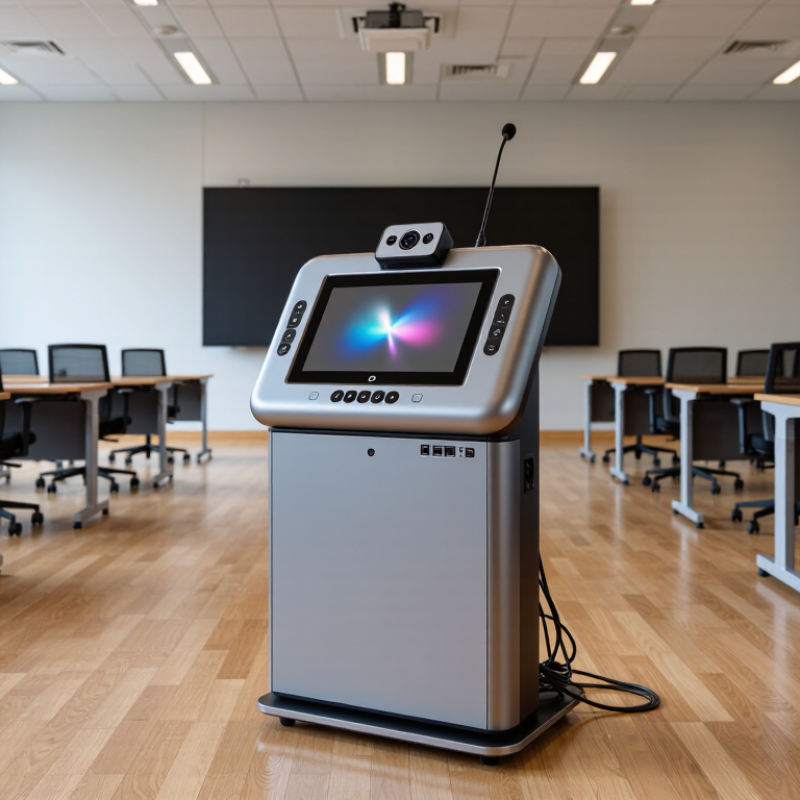
A smart lectern combines a touch display, computer, microphones, cameras, connectivity, and control software in one teaching station. It can manage lessons, display documents, record sessions, and connect remote participants. The design sounds simple. It is not.
The manufacturer matters because hardware reliability directly affects teaching time. A loose hinge, weak cooling system, or unstable operating system can interrupt a lecture within seconds. China’s leading lectern manufacturers should demonstrate tested components, clear firmware support, and traceable quality procedures. Their microphones must capture speech across a moving classroom, not only beside the podium. Their screens also need suitable brightness, low glare, and accurate touch response. The UNESCO Global Education Monitoring Report 2023 states that only about 40% of primary schools worldwide had internet access for learning in 2022. Therefore, a reliable lectern should support offline files and local device connections. Cloud dependence is convenient, but it is not always practical.
Tips: Ask for a live demonstration, not only a specification sheet. Test boot time, fan noise, cable access, camera framing, and recovery after power loss. Request warranty terms and spare-part availability in writing. A low purchase price may conceal expensive downtime. That is easy to miss. I would also question impressive artificial intelligence claims unless the supplier provides measurable accuracy data. Some evaluations remain too optimistic. Real classrooms are messier than showrooms, and manufacturers should prove performance there.
| Evaluation Dimension | Verified Industry Fact | Why the Manufacturer Matters | Recommended Buyer Check |
|---|---|---|---|
| Integrated Display | A smart lectern commonly combines a built-in display with controls for presentations, teaching software, or meeting content. | The manufacturer determines panel quality, touch responsiveness, viewing angle, brightness, and the consistency of system integration. | Confirm screen size, resolution, touch technology, brightness, viewing angle, and replacement-part availability. |
| Embedded Computing | Many smart lecterns use an integrated computer or controller to run presentation, collaboration, recording, or classroom-management applications. | A qualified manufacturer can match processing capacity, memory, storage, cooling, and operating-system support to the intended workload. | Request the processor class, memory, storage type, operating system, upgrade path, and service access method. |
| Audio System | Lecterns may include microphones, speakers, audio inputs, and audio processing for local or remote communication. | Acoustic design and signal processing affect speech clarity, feedback control, volume consistency, and ease of maintenance. | Check microphone type, speaker output, echo cancellation, feedback suppression, audio inputs, and independent volume controls. |
| Camera and Video | A camera can support video conferencing, lecture recording, document presentation, or remote instruction. | The manufacturer influences camera placement, image quality, privacy features, cable routing, and compatibility with conferencing software. | Verify camera resolution, field of view, privacy shutter, mounting position, video outputs, and software compatibility. |
| Connectivity | Typical connectivity may include wired network access, wireless networking, display outputs, USB ports, and computer or media inputs. | Proper integration reduces cable clutter and improves compatibility between the lectern, display equipment, network, and peripheral devices. | List required ports and protocols, then confirm network security, wireless support, signal switching, and cable-management provisions. |
| Height and Ergonomics | Adjustable lecterns can support seated or standing presenters and improve comfort during extended use. | Mechanical design affects adjustment range, stability, load capacity, operating noise, and long-term durability. | Measure the required height range, tabletop area, maximum equipment load, adjustment method, stability, and pinch-point protection. |
| Accessibility | Accessible equipment should support clear reach zones, readable controls, appropriate working height, and compatibility with assistive technology. | Manufacturing quality and customization capability determine whether the lectern can meet site-specific accessibility requirements. | Review control height, reach distance, wheelchair clearance, captioning support, tactile labels, and local accessibility standards. |
| Security and Privacy | A networked lectern can store credentials, connect to institutional systems, and process audio or video data. | Secure firmware, access controls, device-management options, and privacy-oriented hardware reduce operational risk. | Ask about user authentication, firmware updates, administrator controls, camera privacy, data handling, and physical equipment locks. |
| Thermal and Electrical Design | Integrated computers and audiovisual equipment generate heat and require suitable power distribution and ventilation. | Engineering quality affects operating stability, component life, noise levels, electrical safety, and ease of inspection. | Confirm ventilation design, power protection, cable separation, electrical certifications for the destination market, and service access. |
| Customization | Smart lecterns may need customized dimensions, finishes, logos, control layouts, or equipment configurations for different venues. | A capable manufacturer can adapt the enclosure and electronics without compromising serviceability or structural performance. | Define customization limits, engineering drawings, sample approval procedures, minimum order requirements, and change-control rules. |
| Quality Control | A smart lectern combines structural, electronic, software, and audiovisual components, so system-level testing is important. | Manufacturers with documented inspection procedures are better positioned to identify wiring, compatibility, software, and assembly problems before delivery. | Request test procedures covering power, ports, touch functions, audio, video, networking, motion systems, and final assembly inspection. |
| Warranty and Support | Smart lecterns require ongoing support for software updates, replacement components, troubleshooting, and system configuration. | Reliable after-sales support reduces downtime and helps preserve compatibility as operating systems and connected devices change. | Compare warranty duration, response time, spare-parts policy, remote support, documentation, training, and local service coverage. |
| Compliance and Documentation | Electronic equipment may be subject to electrical safety, electromagnetic compatibility, environmental, and market-specific requirements. | The manufacturer is responsible for selecting compliant components and supplying accurate technical documentation for the target market. | Request applicable declarations, test reports, user manuals, wiring diagrams, installation instructions, and maintenance documentation. |
| Total Cost of Ownership | The purchase price is only part of the cost; installation, software, energy use, maintenance, upgrades, and replacement parts also affect value. | Product architecture and support quality influence lifecycle expenses more than the initial quotation alone. | Evaluate five-year operating costs, consumables, software fees, energy requirements, upgrade costs, downtime risk, and disposal needs. |
This manufacturer-neutral framework can be used to compare smart lectern suppliers without relying solely on brand recognition or initial price.