

What Is a Migraine Cap Maker?

Migraine affects daily life in ways a statistic cannot fully show: a dark room, missed work, and a cold cloth that slips out of place. The World Health Organization reports that headache disorders affected about 3.1 billion people in 2021. Its fact sheet identifies migraine as a major cause of disability worldwide. These figures describe a substantial health burden, not proof that any single product will relieve symptoms.

A Migraine Cap Maker designs and produces wearable caps intended to provide cooling, gentle pressure, or both. The work may involve selecting flexible fabrics, shaping gel packs around the forehead and temples, and checking fit, seams, and cold retention. Small details matter. A cap that feels soothing to one person may feel too tight or too cold to another. That is an imperfect part of product design, and it deserves honest attention.

This overview explains how manufacturers turn user needs into a physical product, from materials and construction to quality checks and packaging. It also considers how makers communicate intended use without presenting a comfort product as a cure. The Global Burden of Disease research published in The Lancet Neurology offers useful context on headache-related disability; it does not establish that migraine caps are clinically effective. Readers should keep that distinction in mind when assessing product claims, supplier expertise, and design choices.
What Is a Migraine Cap Maker?

What a Migraine Cap Maker Is and What It Produces

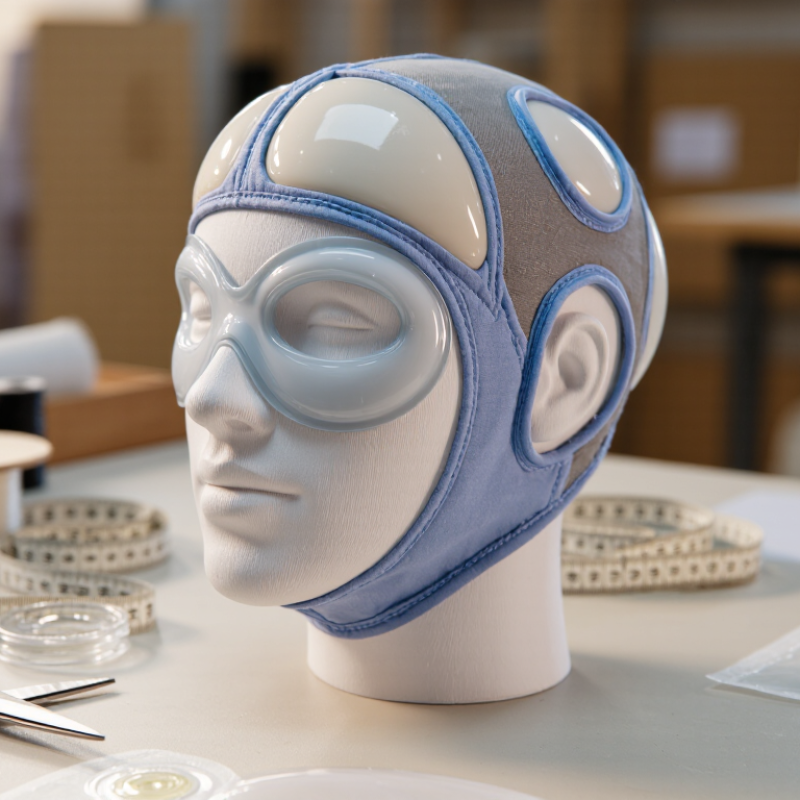
A migraine cap maker designs and produces wearable cold-comfort caps for people seeking a quiet, hands-free option during migraine episodes. Typical products use a stretch-knit outer shell and flexible gel or foam panels that cover the forehead, temples, and sometimes the back of the head. Makers choose materials for softness, seam placement, fit, and repeated chilling. Some caps pull on like a soft helmet; others use adjustable panels. The details matter: a stiff seam near the temple can feel distracting when someone is already sensitive to pressure.

The World Health Organization’s Headache disorders fact sheet estimates that migraine affected about 14% of people worldwide in 2021. That scale helps explain the demand for comfort-focused products, but a cap is not a proven cure or a substitute for medical care. Makers typically produce samples, test stretch and cooling performance, and check whether the cap stays in place without feeling overly tight. The category is not perfectly standardized, and “cooling” can mean different things across products. That deserves clearer testing.

Tips: Check the care label and cooling instructions before use. Fit matters most. Try the cap briefly at first, and stop if it causes discomfort. Keep a simple note of how coldness, pressure, and wear time feel; personal responses can vary.

How Migraine Caps Are Designed for Fit and Cold Therapy

A migraine cap maker designs headwear to stay in place while delivering a cool sensation. Fit begins with the shape of the panels and the stretch of the fabric. A cap that slips may leave the forehead uncovered; one that presses too firmly can feel uncomfortable. Small details matter. Seams should not rub near the temples, and the opening should accommodate different hairstyles. There is no single fit for every head. That trade-off deserves attention.

Cold therapy depends on more than how long a cap stays in a freezer. Makers consider how evenly the cooling material sits around the forehead and sides of the head, and whether the cap remains flexible when chilled. Clear care instructions matter, too. Users should follow the product’s guidance and avoid placing very cold material directly against sensitive skin for extended periods. Cooling may feel soothing for some people, but it is not a cure. Testing across different head shapes and comfort preferences can reveal flaws, though no design will suit everyone. That part is still imperfect.

Materials and Components Used in Migraine Caps

A migraine cap maker develops and assembles a close-fitting, flexible cap, choosing materials that can rest comfortably around the forehead, temples, and back of the head. Many designs use a stretch-knit outer layer and sealed pockets containing reusable cooling gel. The fabric needs enough give to fit different head shapes without pulling tightly. The gel should remain contained, even when the cap is folded for storage. Small details matter. Smooth seams can reduce rubbing, while a soft inner surface feels less abrasive against sensitive skin.

Some caps include removable gel inserts; others have gel distributed through sewn compartments. Each construction has trade-offs. Removable inserts may be easier to clean around, but can shift if their pockets fit loosely. Integrated gel may feel more even, though the cap can be heavier. A maker should test flexibility, stitching, and fit, then describe care and chilling instructions clearly. Not every fabric feels comfortable to every person. That part is easy to overlook. Materials alone cannot establish that a cap will relieve symptoms, so dependable product information should distinguish construction details from health claims.

Materials Used in Migraine Caps: Approximate Specific Heat Capacity

Water-rich gel provides much of a cap’s thermal mass, while polyester or nylon-spandex fabrics are commonly used for the flexible outer covering. Some designs may also use a thin polyethylene liner. Values shown are approximate specific heat capacities in joules per gram per degree Celsius; actual gel formulations and fabric blends vary, and not every cap uses all of these materials.

How Makers Manufacture and Test Migraine Caps

A migraine cap maker turns a design into a wearable product through material selection, pattern cutting, assembly, and testing. The Global Burden of Disease Study 2021 estimated that migraine affected about 14% of people worldwide. That scale makes comfort and consistent construction important. Makers may check fabric stretch, seam strength, gel distribution, and whether the cap stays in place during ordinary movement. A flat sample can pass a test while a finished cap still pinches. Fit matters.

Testing can combine textile standards with product-specific checks. ASTM D5034 measures fabric breaking strength; ASTM D737 measures air permeability; ISO 105-C06 assesses colorfastness to washing. These methods offer measurable results, but they do not certify migraine relief. For a reusable cap, manufacturers can also document cold-storage trials, leakage checks, and repeated flexing, using consistent conditions and recording failures. Small details count: a rough seam near the temple, for example, may make a cap uncomfortable. There is no single universal test protocol for migraine caps, so buyers should look for clear methods and results rather than broad claims. A maker’s process is only as reliable as its records.

What Is a Migraine Cap Maker? - How Makers Manufacture and Test Migraine Caps

Production Stage What the Maker Does Common Materials or Equipment Typical Quality Checks Why It Matters
Product and pattern design Develops the cap shape, coverage areas, fit, seams, and opening or closure details to match the intended use. Design drawings, pattern templates, sample fabrics, fit models Reviews dimensions, pattern alignment, coverage, and fit across intended head sizes. A well-designed cap should sit securely and provide the planned coverage without undue pressure.
Material selection Selects stretch fabrics and, for gel-filled designs, a flexible enclosure material compatible with the cooling gel. Knitted or stretch fabric, flexible film or sealed pouches, cooling gel Checks material appearance, thickness, stretch recovery, and supplier documentation; verifies materials meet the product specification. Material properties affect comfort, durability, flexibility, and how the cap responds to chilling.
Cutting and preparation Cuts fabric panels and prepares gel compartments or liners according to the approved pattern. Cutting dies or fabric cutters, pattern guides, pouch components Checks cut dimensions, edge quality, panel orientation, and component count against the work instructions. Accurate preparation helps prevent poor fit, uneven coverage, and assembly defects.
Gel filling and sealing For gel-filled caps, meters the gel into flexible compartments and seals the enclosure before it is fitted into the cap. Gel-filling equipment, heat-sealing equipment, flexible pouch material Inspects seals and pouch appearance; performs leak checks using a method defined by the product specification. Secure containment helps prevent gel leakage during normal handling and use.
Sewing and assembly Joins fabric panels, inserts or attaches the cooling components, and adds any closures or finishing details. Sewing machines, thread, liners, gel inserts, closures Checks seam continuity, stitch quality, alignment, loose threads, and secure attachment of components. Consistent assembly supports comfort and helps the cap retain its shape during use.
In-process inspection Reviews the product during assembly so defects can be corrected before final inspection. Inspection checklist, measurement tools, visual inspection lighting Checks dimensions, workmanship, component placement, and visible damage at defined production points. Finding issues early reduces the chance of defective products reaching final packing.
Cooling and flexibility evaluation Evaluates how the assembled cap behaves after chilling under the storage and use conditions stated in its instructions. Temperature-controlled storage, thermometer, timing records Checks that the cap remains intact and sufficiently flexible for its intended use after the specified chilling procedure. Some gel products can become firmer when cold; performance should match the product’s instructions and design.
Fit and comfort assessment Assesses how the finished cap fits and whether seams, edges, or closures create obvious discomfort. Finished samples, fit assessment checklist, intended-size references Reviews coverage, stability, ease of putting on and removing, and potential pressure points. Fit and comfort are important because users may wear the cap while resting.
Final inspection and packing Completes a final review, packs the cap, and includes care, storage, and use instructions. Packaging materials, product labels, inspection records Checks appearance, packaging condition, label information, and inclusion of the correct instructions. Clear instructions help users store, clean, and chill the product as intended.

Note: Manufacturing methods and acceptance criteria vary by design. Test limits should be set in the maker’s product specifications; there is no single universal test standard for all migraine caps. A migraine cap is a comfort product and should not be presented as a substitute for medical care.

Factors to Consider When Choosing a Migraine Cap Maker

What Is a Migraine Cap Maker?

Factors to Consider When Choosing a Migraine Cap Maker

A migraine cap maker designs or produces headwear intended to provide cooling or gentle pressure. These caps are not a cure, and individual comfort varies. Look for clear product information rather than promises of guaranteed relief. Small details matter.

Check the materials, stitching, and fit. A cap should sit securely without pressing painfully around the temples or eyes. Ask whether the fabric is washable and whether seams could irritate sensitive skin. If the cap uses gel inserts, the maker should explain how to chill or warm them safely. Instructions should be specific, not vague.

Consider how the maker handles quality and customer questions. Transparent sizing guidance, care instructions, and accessible support can help you judge whether a cap suits your needs. A maker should describe limitations and avoid presenting the product as a substitute for medical advice. It is easy to focus only on cooling claims; I would also consider weight, light blockage, and how quickly the cap feels comfortable. These factors are personal, and a short trial may not answer everything. If symptoms are severe or changing, consult a qualified healthcare professional.

137 Seacoast Ave, New York, NY 10094
+1 (234) 466-9764
Excuisite food, unforgettable atmosphere...